Can't upgrade PHP? Block PHP2Shell with a WAF
In October 2026, PHP disclosed two critical remote code execution (RCE) vulnerabilities, CVE-2026-109618 and CVE-2026-109619, together named "PHP2Shell". The only complete fix is to upgrade PHP. The versions most exposed are the ones that cannot be upgraded: PHP 7 and older are end-of-life and get no official patch, even though they share the same vulnerable code. This post summarizes the vulnerabilities, shows how far a web application firewall (WAF) can protect an application that has to stay on an unsupported version, and where that protection stops.
Upgrade PHP first
A WAF does not remove a vulnerability. It only blocks the requests that try to exploit it. Every vendor that published guidance says the same thing:
- Cloudflare deployed protections for its customers and states that WAF rules are defense in depth. Its advice is to patch PHP.
- AWS published managed and custom AWS WAF rules. It states that a WAF lowers the risk for applications that accept multipart uploads but does not remove it, and that patching is the only complete fix.
The fixed PHP versions are:
| Branch | Fixed version |
|---|---|
| 8.2 | 8.2.35 |
| 8.3 | 8.3.36 |
| 8.4 | 8.4.27 |
| 8.5 | 8.5.12 |
Versions 5.4 to 8.1 get no official fix. The vulnerable code is the same across these versions, so PHP 7 behaves like PHP 8. If you must stay on an unsupported version, a WAF in front of the application is the most practical stopgap.
The two vulnerabilities
| CVE-2026-109618 | CVE-2026-109619 | |
|---|---|---|
| Advisory | GHSA-w8hw-w9fx-j79w | GHSA-6wmf-4rv5-p3rp |
| Class | Out-of-memory (OOM) handling leaves the engine in an invalid state | Stale global state is reused across requests in a PHP-FPM worker |
| Severity | CVSS 9.2 (critical) | CVSS 9.2 (critical) |
| Authentication | Not required | Not required |
Both affect PHP from 5.4.0 up to 8.5.11. Both start in session.upload_progress, a PHP feature that is on by default. When a multipart request contains a field named PHP_SESSION_UPLOAD_PROGRESS, PHP records upload progress in a session file while it parses the body. This happens before application code runs, even if the application never calls session_start().
Upgrading PHP does not remove every risk. Even a fixed PHP version stores the raw file names of uploads in the session file, so PHP code written into a file name can still lead to code execution if the application has a local file inclusion (LFI) flaw.
For the full technical analysis, including the six defects in the PHP source and what the patch changes, read:
- Qi Deng's PHP2Shell write-up, the original research.
- The PHP advisories GHSA-w8hw-w9fx-j79w and GHSA-6wmf-4rv5-p3rp, for affected versions and the official fix.
- ikow/php2shell-poc, the public proof of concept.
What a WAF can see
Most of the attack surface is in the request. These request shapes stand out:
- A multipart
POSTthat contains a field namedPHP_SESSION_UPLOAD_PROGRESS. This is the entry point for the attacks that go through the session file. Normal applications almost never send it. - A multipart body with an extreme number of part headers.
- A multipart body with many file parts that have an empty file name.
- A very large body with no declared length.
A WAF cannot see these parts:
- An unsafe
unserialize()call, or the file inclusion step of the session-file attack, happens in the application's own code. - The step of CVE-2026-109619 that reads the stale state happens inside the PHP worker.
- If the application uses a different
session.upload_progress.name, requests do not contain the default field name.
AWS and Cloudflare make the same points. AWS notes that its rules cannot parse the internal structure of multipart bodies and that header amplification below its size limit is not caught. Cloudflare notes that sites that changed session.upload_progress.name are not covered by its rule.
Protections in Barbacana
Barbacana 0.10.0 adds three protections to the WAF Protection Catalog. All are on by default.
| Leaf | What it blocks |
|---|---|
php-php2shell-session-upload-progress |
A POST that carries the PHP_SESSION_UPLOAD_PROGRESS field. This covers the attacks that go through the session file. |
php-php2shell-part-headers |
A multipart body with more than 4000 part header lines in total, or a part whose header block is too large to parse. |
php-php2shell-empty-file-controls |
A multipart body with more than 20 empty file controls. 20 is the PHP default for max_file_uploads. |
Bodies with no declared length are buffered up to the accept.max_body_size limit (10 MB by default) and rejected with 413 when they exceed it, in every mode, so a chunked stream cannot grow without a limit. The request-body rules inspect bodies sent with Transfer-Encoding: chunked the same way as any other body.
A block means the request has the shape of the attack. It does not mean that PHP was exploited.
To turn off one of these leaves for a route, use disable::
routes:
  - match:
      paths: ["/uploads"]
    upstream: http://app:9000
    disable:
      - php-php2shell-empty-file-controls   # form has 30 optional file inputs
Disabling a leaf removes the block at the edge. It does not change the vulnerability in PHP.
How we tested this
We validated the protections against the public proof-of-concept lab, ikow/php2shell-poc, running the repository's own exploit and verifier scripts unmodified. The lab runs the vulnerable PHP 8.2.34, the end-of-life 7.4.33 (which has no official fix), and Apache mod_php 8.2.34, with Barbacana in front in blocking mode. Everything ran on 127.0.0.1 only, in containers without extra privileges.
Every vector was blocked before it reached PHP
The recording below runs the chain-A exploit twice against the same unpatched PHP 7.4.33: once directly, once through Barbacana.
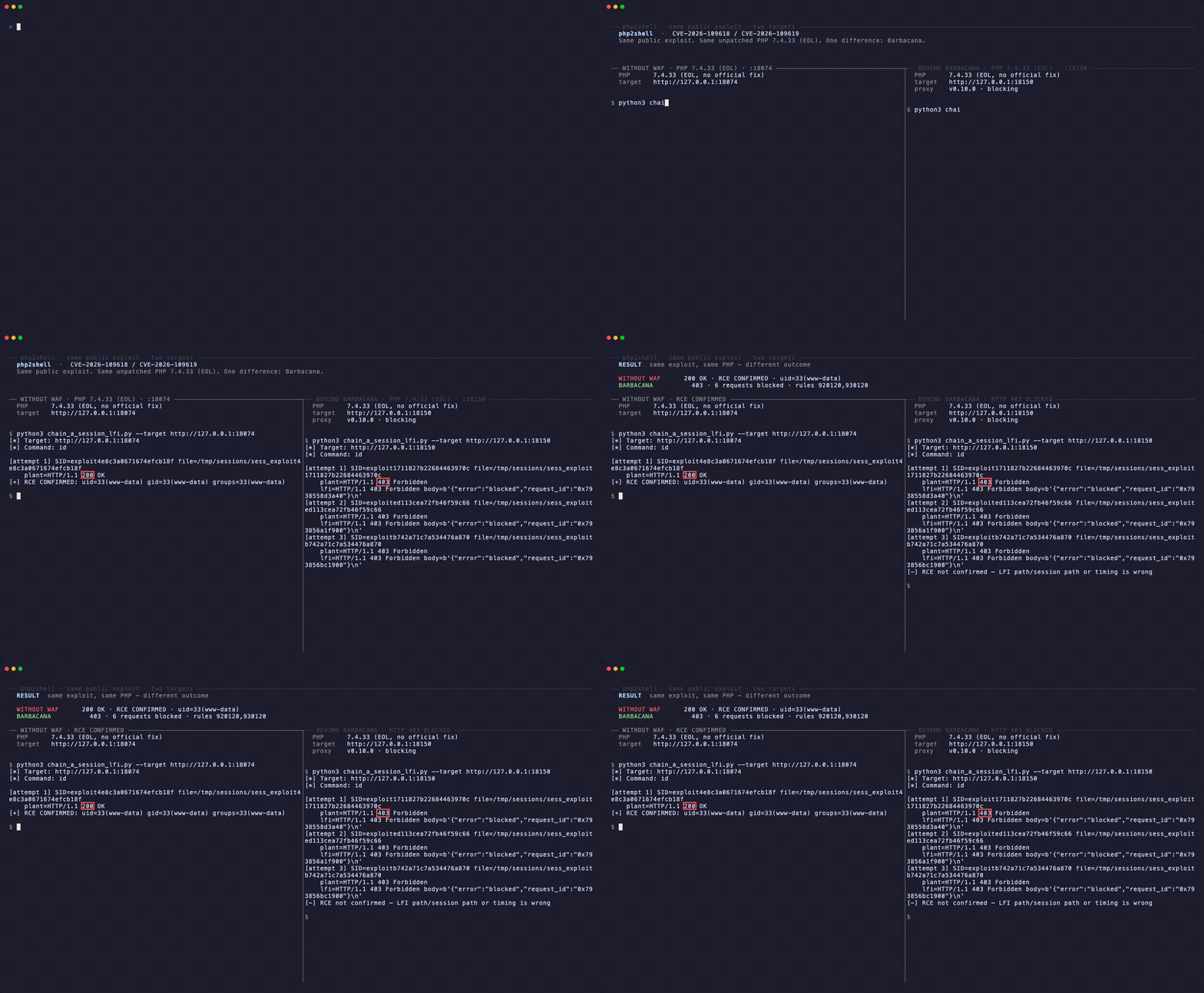
Same public exploit, same end-of-life PHP: RCE CONFIRMED without a WAF; every request blocked with HTTP 403 behind Barbacana. (open full-size)
- Without Barbacana, the session-file exploits ran code on PHP 8.2.34 and 7.4.33. With Barbacana in front, they did nothing.
- Barbacana rejected the memory-exhaustion requests.
A clean multipart upload still passes, and disabling the protections re-opens the attack, which shows the blocks come from these protections. If you run an application that cannot be upgraded, put a WAF in front of it.
Known weaknesses
We list the limits here so that you can decide what else to put in place. Each is something you can act on as an operator.
- Renamed progress field. If your application sets
session.upload_progress.nameto another value,php-php2shell-session-upload-progressdoes not match it. Change the setting back to the default, or turn the feature off withsession.upload_progress.enabled = 0. - Large bodies that are not multipart. A multipart upload of any size up to
accept.max_body_sizeis inspected, because the contents of uploaded files do not count againstmax_inspect_size(128 KB by default). A body that is not multipart, such as a rawPUTupload, is rejected with413when it is larger thanmax_inspect_size. For routes that need such bodies, raise the limit or disableresource-limits-max-inspection-sizeon that route. With the protection disabled, only the firstmax_inspect_sizebytes are inspected. - Application-level flaws. An unsafe
unserialize()call and the file inclusion step of the session-file attack happen in your application code, not in the request. A WAF cannot see them. Only upgrading PHP and fixing the file inclusion flaw close them.
Let your AI agent set it up
The PHP2Shell protections are on by default, so a default Barbacana install in front of your application already blocks the request shapes described in this post. Barbacana is open source (Apache 2.0) and runs on your own server, so your traffic does not pass through a third party.
The Barbacana skills let an AI coding agent, such as Claude Code, Codex, or Cursor, do the install for you. Install them:
Then open your agent in the directory of your PHP application and ask, for example:
Put Barbacana in front of the PHP application in this directory to protect it against PHP2Shell. Read https://barbacana.dev/blog/2026/10/26/cant-upgrade-php-block-php2shell-with-a-waf/ first. Start in detect-only mode so we can check for false positives.
The agent proposes each step, validates the configuration with barbacana --validate before it runs anything, pins a release version, and finishes with a smoke test. When the audit log shows no false positives, ask the agent to switch the route to blocking mode.
Final thoughts
The most effective step is to upgrade PHP to a fixed version. The steps below are for applications that cannot do that yet.
- Put Barbacana in front of the application. To check for false positives first, run the route in detect-only mode.
- Set
session.upload_progress.enabled = 0inphp.iniand restart PHP. This makes CVE-2026-109619 harder to exploit, but it does not fix CVE-2026-109618. - If your application does not need file uploads, leave
multipart/form-dataout ofaccept.content_typeson those routes. - Set
accept.max_body_sizeto the largest body your application needs. - On PHP 8.5, AWS also recommends setting
fatal_error_backtraces=0. Check the AWS post for the reason and the exact scope. - Add alerts for
Allowed memory size ... exhaustedandSession object destruction failedin your application logs, and for bursts of HTTP 502 responses from PHP-FPM. - Plan the upgrade to a fixed version, or a vendor backport for versions without official support.
- To get help with these steps, ask your AI coding agent. See Let your AI agent set it up.
Sources
- AWS: Using AWS WAF to apply mitigations for PHP2Shell RCE vulnerabilities
- Cloudflare: protections against the php2shell vulnerability
- Qi Deng: PHP2Shell write-up
- PHP security advisory GHSA-w8hw-w9fx-j79w (CVE-2026-109618)
- PHP security advisory GHSA-6wmf-4rv5-p3rp (CVE-2026-109619)
- Public lab proof-of-concept with WAF bypass notes
- Public proof-of-concept repository — ikow/php2shell-poc